ENSCI Les Ateliers — Diploma Project
If a robot doesn't need to look human, what should its face be? Three robotic heads, one shared body, zero screens.
↓ Discover the specimensThe uncanny valley isn't a law of nature — it's what happens when imitation is the only strategy. What if machines had their own face? Legible, expressive, non-human.
Temperature as language.
Liquid crystal paint on hand-embossed aluminium. Six independent Peltier zones shift colour in ~2 seconds. Each thermal state produces a pattern the viewer reads like an inkblot.
Flow as language.
Fluorescent liquid circulates through silicone channels driven by peristaltic pumps. Fast reads as agitation, slow as calm. A chromatophore system built from medical-grade tubing.
Tension as language.
0.5mm nitinol wires contract at 70°C, animating antenna-like structures. Auxetic geometries amplify micro-movements into visible surface deformations. Near-silent. No motors.
The body all three faces share.
3-axis motorised neck (pan, tilt, roll). Three iterations from bulky to compact. 12 PLA-printed parts, 3 MG996R servos, 30 minutes to assemble.
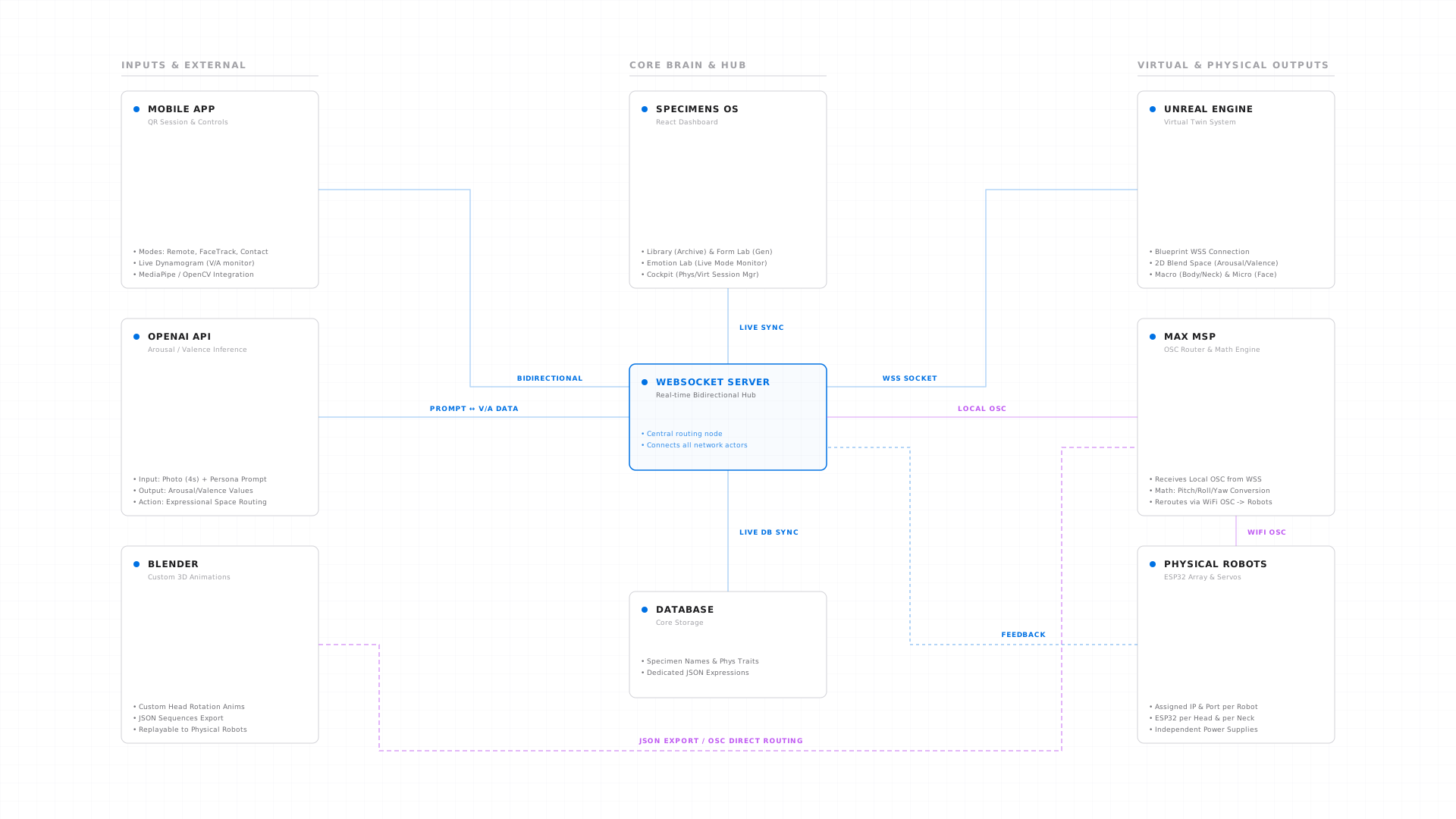
Each specimen is a combination of parameters. An expression engine translates internal states into physical dynamics. The project focuses on heads — the system is designed for the whole body.
Explore the full research →Each specimen is defined by combinable parameters — structure, surface, movement, colour. Variations produce individuals. The system generates diversity beyond what a single designer could imagine.
A live reaction-diffusion simulation shaped by the robot's internal states. Six parameters drive the output — a six-dimensional space of possible expressions, readable by humans or owned by AI.
7 months of iteration. Silicone casting, metal embossing, SLA printing, nitinol bending, electronics soldering. Most experiments failed — all taught something. Three heads emerged from hundreds of tests.
Tools & processes